

2024 IMPACT REPORT
Deepening our network roots,
growing new shoots of impact
Rhode Island Food System Highlights

$12B
of economic output annually
8,300 businesses in the state’s food sector host 12.6% of all RI jobs, employing over 73,000 people

$3.5M
paid in tipping fees associated with wasted food annually
75,600 tons of valuable food and seafood shells go into RI’s near-capacity landfill every year.

$17.5K
per acre for the most expensive farmland in the country

$107M
of seafood is landed annually
Longfin and shortfin squid account for 53% of pounds landed by 720 commercial fisheries while 84 aquaculture farms generate over $8 million in sales

89,100
Rhode Island households receiving SNAP benefits
Hispanic and Black Rhode Islanders are much more likely to receive SNAP benefits than White Rhode Islanders, supplementing food purchases for 36.3% of Hispanic households, 28.3% of Black households enrolled, and 10.1% of White households.

140,721
Students receive free or reduced-price school meals annually
45% of enrolled students are eligible to receive free school meals. 38% of RI households are food insecure.
LETTER FROM RIFPC PRESIDENT DIANE LYNCH
A year of expanding leadership and impact

The Food Policy Council had another year of tremendous growth in 2024. We grew our staff and launched new programs, saw another big expansion in our network membership, and achieved a whole new level of advocacy at both the state and federal levels.
Our growth was fueled by the generosity, vision and hard work of all of our staff and network members. We cannot thank you enough for what you have achieved! While it sometimes felt chaotic and messy, our combined work was always focused on ways to make our local food system more resilient, more sustainable, and more truly equitable.
READ MORE
To name just a few highlights from 2024:
Our state advocacy tackled some of the most difficult and long-standing challenges in Rhode Island’s food system: preserving our dwindling farmland, growing our small and urban farms, reducing the wasted food clogging up our landfill, and ensuring that all of Rhode Island’s schoolchildren are fed well during the school day. Meeting each of these challenges is a multi-year process. The workgroups that supported state legislation in each of these areas educated lawmakers and built coalitions and will continue their work in 2025 and beyond. We celebrated one big win: placing $5 million in the Green Bond for farmland preservation.
For the second year a Council workgroup actively advocated at the federal level, focused on the Farm Bill. By joining the National Sustainable Agriculture Coalition (NSAC), Council members were able to access real-time updates and analyses of Farm Bill negotiations and appropriations. Although Congress was too gridlocked to pass a new Farm Bill in 2024, network members and staff were able to educate our congressional delegates on which Farm Bill programs and funds were most important to the health of our local food system, and they will continue to advocate until the next Farm Bill is passed (hopefully in 2025).
The Council launched a multi-year program that brings together a broad coalition of local organizations and farmers to support the viability and growth of small, beginning, and traditionally under-served farmers in Rhode Island. Funded by the USDA, this multi-year program will allow local service organizations to better understand and meet the technical needs of these farms.
The Council led the development of a state-wide plan for ensuring adequate food access for all Rhode Islanders in the event of a prolonged disruption to our food system. Akin to other emergency management plans, this plan was developed with ongoing input from community-based organizations, state agencies, and emergency management organizations. The final plan will be published in 2025.
The Council brought together ‘Food as Medicine’ practitioners from across the state and region to understand how current efforts to increase access to healthy food for all Rhode Islanders are working, and to agree on how to increase access going forward. This multi-year effort will connect and coordinate the work of health service providers, community-based organizations, and local farmers and food aggregators.
We took a leadership role in the state’s annual composting conference and began working closely with municipalities across the state to develop ways to reduce food waste going to the landfill and increase composting capacities.
As part of our growth, our organizational structure continues to evolve. Our staff continues to experiment with the best ways to connect and support the individuals, communities, and coalitions that make up our network. We know that the strength of our network is our foundation for meeting the challenges ahead of us and we are preparing for another powerful year in 2025.
Yours,
Diane Lynch
Board President
RIFPC’s Strategic Objectives 2023-2025

Increase food access, security, justice, and sovereignty for marginalized Rhode Islanders by coordinating and advocating for changes that enable all people to eat healthy, nutritious, culturally and religiously appropriate food of their own choice, regardless of zip code.
Support the economic strength and resilience of RI food businesses, especially those that have been historically under-served and/or under-resourced.
Create, contribute to, and advocate for policy that integrates climate, justice, environment, and food recovery in a way that centers social responsibility and economic equity at the municipal, state and federal levels.
Provide leadership, resources, and direction to state food system planning and policymaking in alignment with RIFPC’s commitment to equity.
Empower the network – current Council, Council alumni, and the broader network – to build community power and affect positive change in alignment with our mission.
2024 HIGHLIGHTS: ADVOCATING, EDUCATING, CONVENING
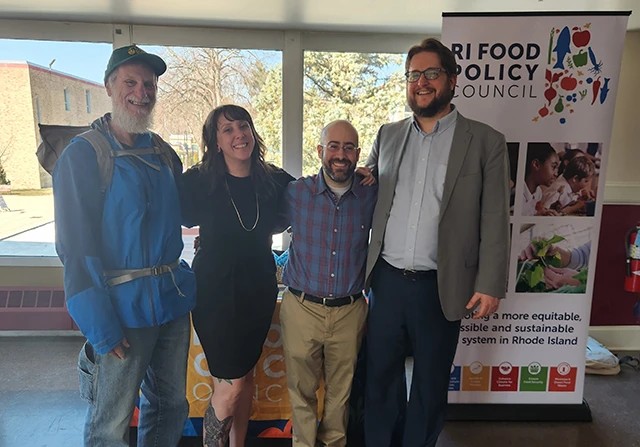
Supporting and advocating for municipal food waste composters
Read More
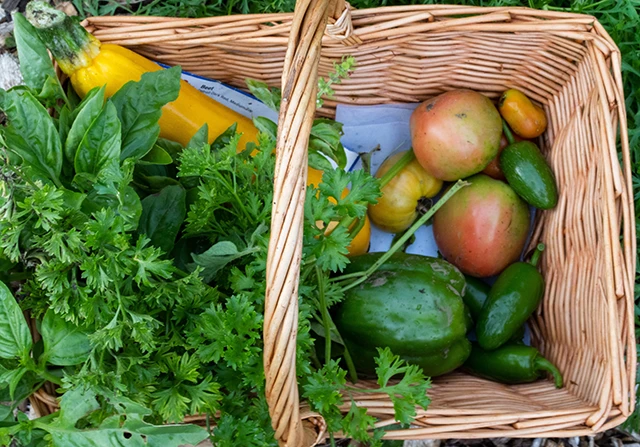
Holding our first-ever produce prescription summit
Read More

Supporting our farms with state and federal funding wins
Read More
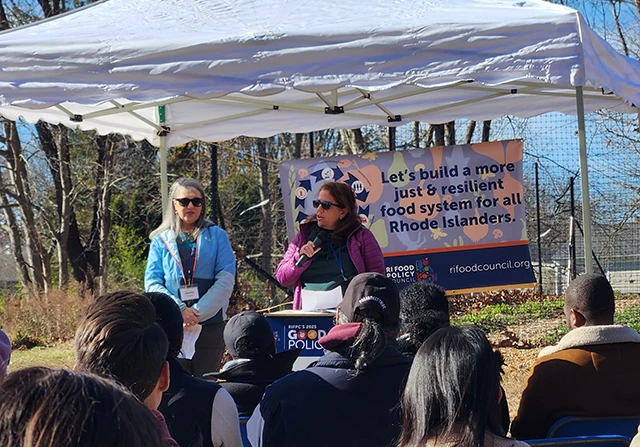
Expanding our reach and impact with new programs, staff, and events
Read More
By the Numbers: RIFPC in 2024
- Food Business & Economic Development
- 29 local farm and seafood business helped
- $415K+ in grant capital for small farmers and fishers
- 300 hours of 1:1 expert business assistance coaching
- Food Access & Nutrition Security
- 115 new partnerships between food hubs and farms
- 104 small farmers with increased revenue of $845K+
- 18 new jobs and 141 maintained jobs
- 97 new local food access points
- 77,900 food-insecure people fed.
- Food, Climate & Environment
- 100+ attendees at Compost Conference co-hosted by RIFPC
- $18.7M grant awarded by Environmental Protection Agency
- 90 partners/members formed a statewide Food Waste Action Network

Policy for the People
Policy for the People, our webinar series designed to demystify local food policy and advocacy, truly took hold in 2024. Sessions ranged from Food Advocacy 101 (how laws are made in Rhode Island and how to influence legislators) to Impact Storytelling, an update on the Farm Bill, a discussion of the Council’s legislative priorities, and more. The free hour-long programs are presented live at noon with recorded videos available afterwards.
“The series was a success right away,” says Executive Director Nessa Richman. “Policy for the People has become our signature educational program. The sessions offer detailed but approachable information for anyone who wants to help build a more just and resilient food system for everyone in the Ocean State—no experience required.”
Our People
BOARD OF DIRECTORS
Diane Lynch, President
Steven J. Arthurs
Courtney Bourns
Amber Jackson
Thea Upham
Staff
Nessa Richman
Executive Director
Josh Daly
Associate Director
Rachel Newman Greene
Food Access & Nutrition Security, Program Director
Max De Faria
Food Access & Nutrition Security Program, Senior Program Associate
Allison Montagnon
Communications Manager
Isaac Bearg
Program Director, Food, Climate & Environment
Rozie Schleinig
Program Director, Food Business & Economic Development
INTERNS
Joleen Owusu-Sekyere
Madeleine Lee
Olivia Capriotti
FINANCIALS
FY 2024: 1/1/2024-12/31/2024
REVENUE
EXPENSES
FUNDING PARTNERS
Our funding partners are critical to our success. We are grateful for their ongoing support, which allows us to leverage innovative, inclusive ideas that create solutions to complex challenges, and foster a healthier, more prosperous food system in Rhode Island as well as the Northeast region.
- 11th Hour Racing Foundation
- Angell Foundation
- Henry P. Kendall Foundation
- Island Foundation
- Point32Health Foundation
- Rhode Island Foundation
- UNFI Foundation
- USDA Agricultural Marketing Service
- USDA National Institute of Food & Agriculture
- USDA Rural Development